
Timeshare Arbitration; What Owners Need to Know!
What Is an Arbitration?
Arbitration is a private method of resolving a legal dispute outside the ordinary court system. Instead of a judge or jury deciding the case, the dispute is normally presented to an arbitrator, who hears the evidence and makes a decision.
When arbitration is described as binding, the resulting decision is normally final and legally enforceable. An arbitration clause in a timeshare contract may therefore determine how a future disagreement between the owner and the timeshare company must be handled.
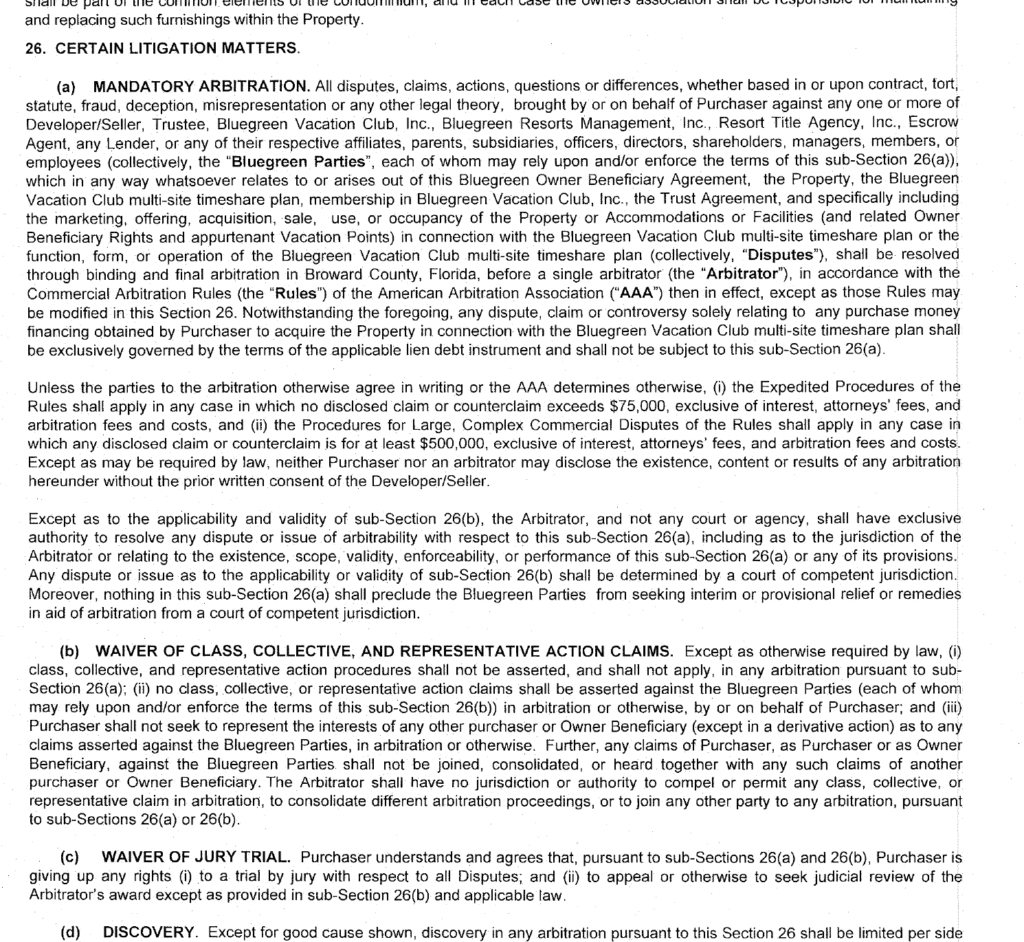
Example of a Mandatory Arbitration Clause
In this example, the contract states that disputes including claims involving fraud, deception and misrepresentation are subject to binding arbitration, while also restricting class actions and jury trials. The exact effect of any clause depends on the individual contract and applicable law, which is why owners should not assume that every arbitration provision works in exactly the same way.
Is Arbitration the Same as Going to Court.
This is the point many consumers do not fully appreciate when signing.
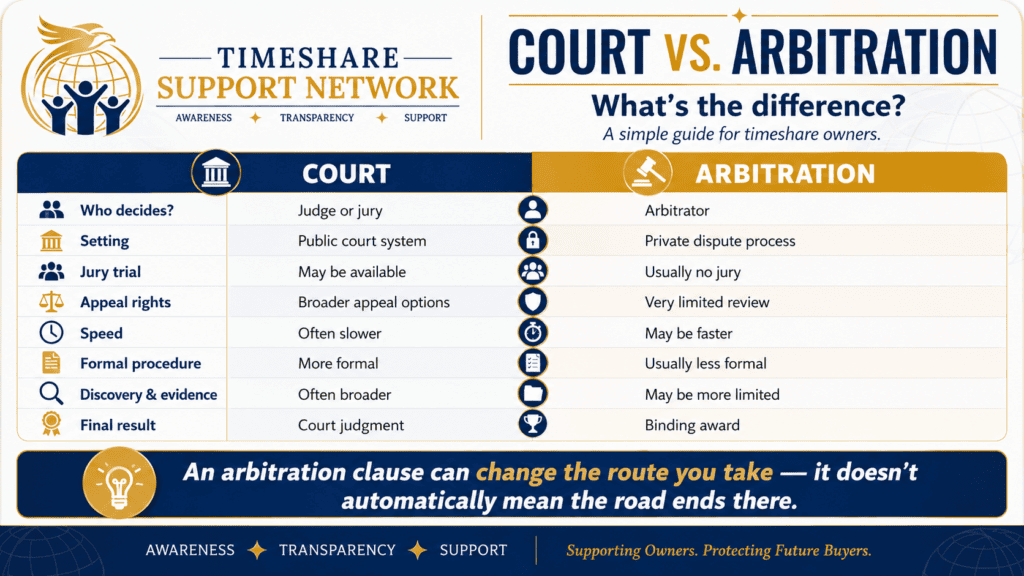
A binding arbitration clause can mean that certain disputes must be brought through arbitration rather than through an ordinary lawsuit.
- no jury
- a private rather than public adjudication process
- different procedures for obtaining documents and evidence
- potentially faster proceedings
- different rules concerning where hearings take place
- very limited opportunities for a court to review the final award
That does not automatically make arbitration unfair. But it does make it something consumers should understand before agreeing to it.
What Words Should You Look For?
When reviewing a timeshare agreement, do not only search for a heading saying “Arbitration.” Look for terminology including:
- ARBITRATION
- BINDING ARBITRATION
- DISPUTE RESOLUTION
- WAIVER OF JURY TRIAL
- CLASS ACTION WAIVER
- DELEGATION CLAUSE
- GOVERNING LAW
- VENUE / FORUM
An arbitration paragraph is not simply administrative small print. It can determine who decides very important questions later.
Is the American Arbitration Association Part of the Timeshare Company?
No.
The American Arbitration Association (AAA) is a not-for-profit alternative dispute-resolution organisation that administers arbitration and mediation. It is not Wyndham, Hilton, Westgate or another timeshare developer.
Importantly, the AAA administrator does not decide who wins the underlying dispute. The administrator handles the arbitration process, while the arbitrator is the neutral decision-maker who ultimately decides the merits of the case.
Does the AAA Simply Accept Whatever the Company Put in Its Contract?
No.
The AAA reviews consumer arbitration provisions to determine whether they materially comply with its Consumer Due Process Protocol. It can refuse to administer arbitrations arising from consumer clauses that do not meet those standards.
Those standards include principles concerning neutral arbitrators, reasonable consumer costs, convenient hearing locations, proper notice of the arbitration clause, access to necessary information, appropriate remedies and a fair opportunity for the consumer to present their case.
This becomes especially important in one of the timeshare cases we will look at later in this guide.
Who Pays for AAA Consumer Arbitration?
AAA consumer rules limit the amount the consumer is required to pay in administrative fees, with fee waivers potentially available for eligible consumers. The business generally pays the remaining administrative costs and the arbitrator’s compensation in consumer cases.
That understandably raises a question for owners: “If the company is paying most of the costs, is the arbitrator really independent?”
The fact that a business pays the arbitration costs does not mean the arbitrator works for that business. The AAA’s Consumer Due Process Protocol requires neutral decision-makers and impartial proceedings.
Even so, it is reasonable for consumers to understand how the system is structured before agreeing to participate in it.
Does Arbitration Work Well for Consumers?
There is no reliable statistic that tells us what percentage of timeshare owners are satisfied with arbitration. The available data covers many different types of consumer disputes, not timeshare specifically.
The American Arbitration Association reported that during 2025, 9,419 individual consumer cases were filed, consumers were awarded more than $26 million, and 3,666 consumer cases were resolved with the consumer paying no fees. However, those figures cover many kinds of consumer disputes.
An older Consumer Financial Protection Bureau study found that, among consumer-finance disputes involving a consumer claim that actually reached an arbitrator decision and where the outcome could be determined, consumers obtained some form of relief in 32 of 161 cases — 20.3%. But that should not be treated as a general consumer arbitration “win rate”, and it was not a timeshare study.
Arbitration can produce awards for consumers, but there is no credible evidence allowing us to tell an individual timeshare owner that arbitration will — or will not — produce a satisfactory outcome in their particular case.
Can an Arbitration Clause Ever Be Challenged?
Yes.
The Federal Arbitration Act strongly supports the enforcement of written arbitration agreements, but that does not mean every arbitration clause must automatically be enforced regardless of the circumstances.
There are legal grounds on which contracts or particular provisions may sometimes be challenged, and there are real timeshare cases in which courts have refused to compel arbitration.
However, the reasons differ significantly from case to case. Owners should never find one successful case online and assume the same result will automatically apply to them.
An arbitration clause can change the route you have to take. It does not automatically mean the road ends there.
Case Study: Gibbs v. Capital Resorts Group
In Brenda Gibbs v. Capital Resorts Group, the timeshare company sought to compel mediation and arbitration. The owner specifically challenged the arbitration arrangements as part of allegations concerning fraudulent inducement.
The trial court refused to compel arbitration, and the Tennessee Court of Appeals upheld that decision.
Why this matters:
A common misconception is: “If the contract contains arbitration, the judge cannot look at anything else.” Gibbs demonstrates that disputes concerning how an arbitration agreement itself was obtained can matter.
But it does not mean that merely alleging fraud somewhere in the timeshare sale automatically invalidates arbitration. The nature of the challenge and precisely which contractual provision is being challenged can be crucial.
Case Study: Steines v. Westgate
U.S. Court of Appeals for the Eleventh Circuit — 2024
This case involved an active-duty U.S. Army servicemember and his wife who bought a Westgate timeshare and financed the purchase through Westgate. Their agreement contained both an arbitration requirement and a delegation provision. When the owners sued, Westgate asked the federal court to compel arbitration.
The owners argued that the Military Lending Act applied to their financed transaction and prohibited enforcement of mandatory arbitration against them. The district court refused to compel arbitration, and the Eleventh Circuit upheld that result.
Why this matters;
The case demonstrates that another federal law can override what would otherwise be an enforceable arbitration requirement.
It does not mean every servicemember who owns a timeshare automatically escapes arbitration. The precise transaction, financing arrangements, military status and applicable law all matter.
The presence of the words “binding arbitration” does not automatically end the legal analysis.
Case Study: Bedgood v. Wyndham Vacation Resorts
U.S. Court of Appeals for the Eleventh Circuit — 2023
This case is particularly interesting for timeshare owners because the owners actually tried to use the arbitration process required by their contracts.
They filed arbitration claims through the American Arbitration Association. But before an arbitrator was appointed, the AAA refused to administer certain claims because Wyndham Vacation Resorts had failed to comply with AAA policies.
The AAA told the owners they could take the dispute to the appropriate court. The owners did so. Wyndham then attempted to have the court send them back into arbitration.
The court refused. The Eleventh Circuit agreed that Wyndham was in default with its contractually selected arbitration forum and upheld the refusal to stay the litigation.
Why this matters;
The Eleventh Circuit did not rule that Wyndham’s arbitration clause was automatically invalid. Instead, the issue was that the AAA had refused to administer the arbitration because of Wyndham’s non-compliance with the arbitration provider’s policies.
That distinction matters. The case shows that even where a contract requires arbitration, the company may still need to comply with the rules of the arbitration organisation it chose.
What Do We Learn From These Cases?
They teach us something far more useful than simply saying “arbitration clauses can be beaten.” That would be an irresponsible conclusion.
Instead, they show that arbitration clauses sit within a wider legal framework. Questions can arise about:
- whether an arbitration agreement was properly formed
- whether the arbitration provision itself was affected by fraud or another contract defence
- whether another law prohibits arbitration in the particular circumstances
- whether the company has complied with the rules of its chosen arbitration administrator
- whether the dispute actually falls within the scope of the arbitration provision
- whether procedural requirements have been followed
These are legal questions. Owners facing an actual dispute should obtain advice from an appropriately qualified attorney in the relevant jurisdiction.
Can You Appeal an Arbitration Decision?
This is another important difference between arbitration and ordinary court litigation.
Under the Federal Arbitration Act, a court can set aside an arbitration award in certain limited circumstances, including situations involving corruption, fraud, evident partiality, serious procedural misconduct, or where arbitrators exceeded their powers.
But this is not the same as an ordinary appeal simply because you believe the arbitrator reached the wrong conclusion.
The AAA’s Consumer Due Process Protocol recognises that court review of arbitration awards is very limited. That is one of the consequences consumers should understand before agreeing to binding arbitration.
Is Arbitration Automatically Bad?
No. And Timeshare Support Network does not need to make that argument.
Arbitration may have advantages in some circumstances. It can potentially be quicker and less procedurally complicated than traditional litigation. The AAA’s Consumer Due Process Protocol was specifically developed to establish minimum standards intended to protect consumers participating in arbitration.
The issue for TSN is more fundamental:
Did the buyer knowingly agree to arbitration and understand what the clause meant?
A person should not discover only after a serious dispute has arisen that they signed away or restricted a method of resolving that dispute without understanding the consequences.
Can You Opt Out of an Arbitration Clause?
Sometimes.
Some contracts contain a provision allowing the consumer to reject the arbitration requirement shortly after signing. Not every contract does, and the deadline and procedure can differ significantly between agreements.
You may be required to:
- send written notice
- send it to a particular address
- identify the contract or account
- include particular wording
- make sure it is received or postmarked before a strict deadline
Never assume you have an arbitration opt-out. Read the actual agreement.
And do not assume an arbitration opt-out period is the same thing as the timeshare rescission period. They are separate rights and may have completely different deadlines and procedures. If you have recently signed, check both immediately.
Recently Signed a Timeshare?
This is one of the most important moments to review the paperwork.
Do not put the contract in a suitcase and decide to look at it when you get home several weeks later. Check immediately for:
- RESCISSION / CANCELLATION
- ARBITRATION / DISPUTE RESOLUTION
If an arbitration opt-out exists, follow the instructions precisely. If you are still inside your timeshare cancellation or rescission period and are considering cancelling the purchase itself, that deadline may be even more urgent.
Time matters.
If you have recently signed and need help locating these sections of your agreement, contact Timeshare Support Network. Our guidance is free.
Already Have a Dispute?
If a dispute has already developed and you discover an arbitration clause, do not automatically conclude either: “I definitely cannot go to court” or “I found a case online where arbitration wasn’t enforced, so mine won’t be either.” Neither conclusion is safe.
- Locate every document connected with the purchase.
- Find the arbitration and dispute-resolution provisions.
- Identify which arbitration organisation is named.
- Look for any delegation clause.
- Look for governing-law and forum provisions.
- Preserve sales materials, emails, texts and correspondence.
- Write down what happened while events are still fresh.
- Obtain qualified legal advice if you are considering litigation, arbitration or challenging the clause.
The relevant attorney will need the actual contract, not simply a description of what you remember signing.
Questions to Ask Before Signing Any Timeshare Contract.
Before committing to a timeshare, ask:
- If I have a dispute with your company, can I take you to court?
- Does this agreement require binding arbitration?
- Who administers the arbitration?
- Where would arbitration take place?
- Who chooses the arbitrator?
- Who pays the costs?
- Does the agreement contain a class-action waiver?
- Does it contain a jury-trial waiver?
- Does it contain a delegation clause?
- Can I opt out of arbitration?
- If yes, how long do I have and exactly what must I do?
- Can I take this contract away and read all of this before deciding whether to buy?
- If the answer is no, ask yourself why?
Why This Reinforces “Never Sign Today”
Timeshare Support Network’s message is not: Never buy a timeshare.
Our message is: Never Sign Today.
A timeshare may involve:
- a substantial purchase price
- years or decades of maintenance obligations
- financing
- exchange arrangements
- usage restrictions
- contractual provisions governing what happens if a serious disagreement develops later
You cannot properly evaluate all of that while sitting in a high-pressure sales environment.
Take the contract away. Read it. Check the financial commitment. Check the cancellation rights. Check the arbitration clause. Check what has been said verbally against what appears in writing. Get independent guidance if something is unclear. Then make the decision when you are ready.
The Bottom Line
An arbitration clause is not automatically unfair. It is not automatically invalid. And arbitration itself is not automatically bad for consumers.
But neither should consumers treat binding arbitration as meaningless small print.
Real timeshare cases involving Capital Resorts, Westgate and Wyndham show that arbitration provisions can become extremely important once a dispute begins — and whether arbitration must be enforced can depend on the facts, the contract wording, applicable law and even compliance with the arbitration administrator’s own rules.
The best time to understand an arbitration clause is before there is a dispute. And ideally: before you sign the contract at all.
READ THE CONTRACT BEFORE THE CONTRACT BECOMES THE PROBLEM.
Our Arbitration Petition Is Now Live
Timeshare Support Network is calling on the United States Congress to require clear, separate disclosure of arbitration clauses in timeshare contracts and give buyers a 30-day right to opt out of arbitration without affecting their purchase.
If you support clearer consumer protection and informed choice, you can add your name to the petition now.
Download the Full Arbitration Guide.
Want to keep this information for later? Download the complete TSN guide, including the detailed case studies, consumer arbitration information and source references.